
The Core Tradeoff: What Each Technology Does Best in 2026
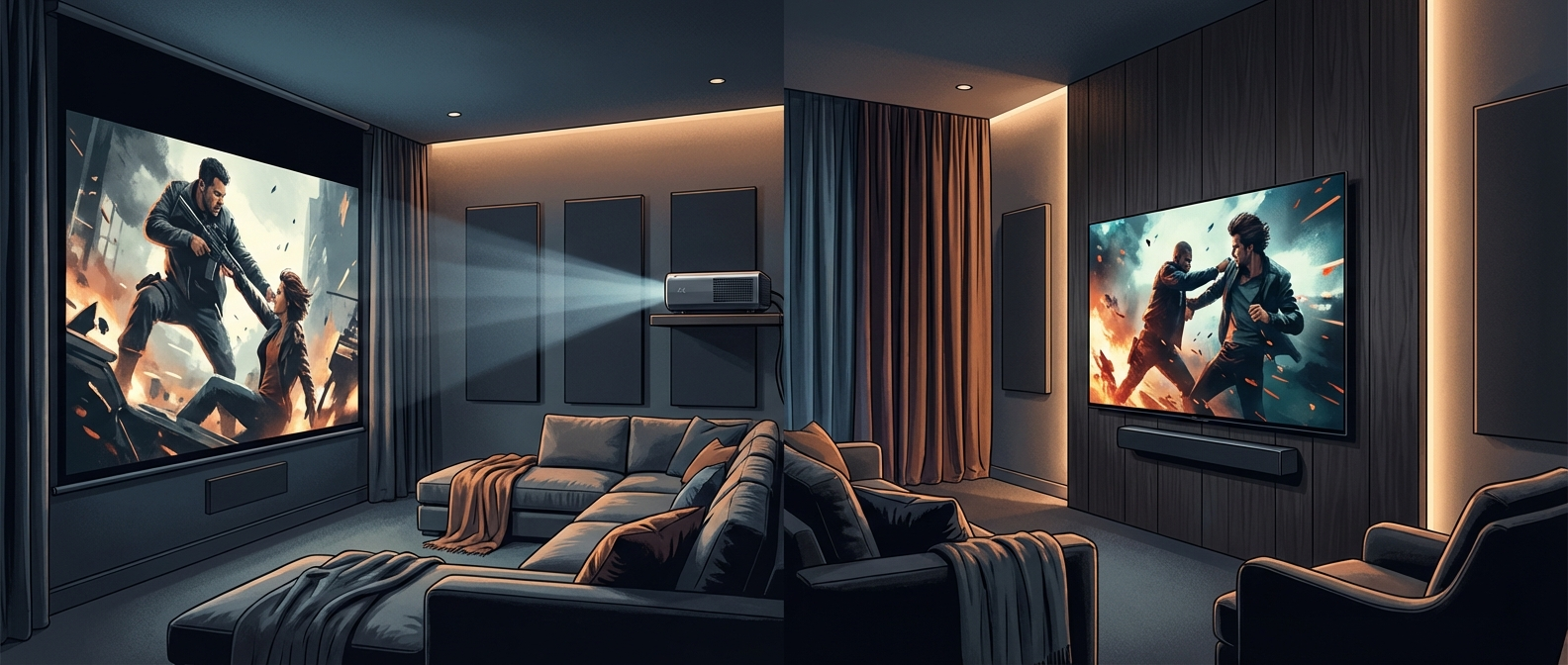
The 4K projector vs OLED TV debate has never been more interesting — or more genuinely competitive. In 2026, the gap between the two technologies has narrowed considerably, but the fundamental tradeoffs remain. OLED TVs deliver self-emissive pixels with infinite contrast ratios and stunning brightness in any lighting condition. 4K projectors, meanwhile, offer screen sizes that no TV can match at any reasonable price, with the best models now producing color accuracy, HDR performance, and contrast that would have been unthinkable five years ago.
The honest answer is this: if you're building a dedicated home theater room with controlled lighting, a high-quality 4K projector will give you a cinematic experience that no OLED TV — regardless of price — can replicate. If you want a premium display for a living room with windows, ambient light, and multipurpose use, a flagship OLED remains the more practical choice. Everything else in this comparison is context for that conclusion.
Screen Size and Immersion: The Projector's Undeniable Edge
Why 100 Inches Changes Everything
Mainstream OLED TVs top out between 55 and 97 inches, with 77-inch models representing the sweet spot for most buyers. Go above 83 inches and prices climb steeply — and at those sizes, transportation and installation become genuine challenges. A quality 4K laser projector, by contrast, can effortlessly produce a 100–150-inch image from a compact ceiling-mounted or shelf-mounted unit.
This isn't just a numbers game. At 100 inches or more, your peripheral vision gets pulled into the image in a way that fundamentally changes the viewing experience. Action sequences feel more physical. Landscape shots become genuinely expansive. The difference between watching a film on a 77-inch OLED and a 120-inch projection screen isn't incremental — it's categorical. Home theater enthusiasts who've made the switch rarely go back.
Optimal Viewing Distances by Screen Size
For projector setups, screen size and room depth need to match. Here's a practical reference guide based on standard recommendations:
| Screen Size | Ideal Viewing Distance | Typical Room Type | Display Type |
|---|---|---|---|
| 77 inches | 8–12 feet | Living room, bedroom | OLED TV |
| 97 inches | 11–14 feet | Large living room | OLED TV (premium) |
| 100 inches | 12–16 feet | Standard family room | Projector |
| 120 inches | 15–20 feet | Larger great room | Projector |
| 150 inches | 19–25 feet | Dedicated theater room | Projector |
Most projectors targeting the home theater market — including the Epson Pro Cinema LS12000 and the Sony VPL-XW5000ES — are designed around that 100–150-inch sweet spot, with throw ratios optimized for standard room depths. Ultra-short-throw projectors compress that setup requirement even further, placing the unit inches from the screen rather than feet away.
Image Quality: Where OLED Leads and Projectors Are Catching Up Fast
Contrast, Black Levels, and HDR
OLED TVs have one genuine, structural advantage: each pixel generates its own light and can switch off completely. This produces true infinite contrast ratios and black levels that no projector, regardless of price, can fully match in a room with any ambient light. For dark scene rendering — the shadow detail in a thriller, the night sky in a sci-fi epic — flagship OLEDs like LG's G-series and Sony's Bravia XR OLED remain the reference standard.
That said, modern laser projectors have narrowed the gap dramatically. Dynamic contrast ratios of 30,000:1 are now achievable on premium models. The Epson Home Cinema LS11000 uses a laser light source with dynamic iris control to produce black levels that, at screen sizes above 100 inches, are difficult to distinguish from OLED in a properly darkened room. At scale, HDR actually works differently on a projector — a 120-inch highlight burst looks more visually impactful than the same content on a 77-inch OLED, even if the raw nit count on the TV is higher.
Newsletter
Get the latest SaaS reviews in your inbox
By subscribing, you agree to receive email updates. Unsubscribe any time. Privacy policy.
Color Accuracy and Brightness
Peak brightness is where OLED TVs currently hold a clear advantage for mixed-lighting environments. A flagship OLED can hit 800–1,000 nits in real-world HDR scenes, maintaining image quality even with lamps on or curtains open. Most projectors in the $2,000–$5,000 range produce 1,500–3,500 ANSI lumens — sufficient for a darkened or semi-darkened room, but not for a bright living room at midday.
Color accuracy, however, has become a genuine projector strength. Tri-laser systems and advanced phosphor designs now routinely achieve Delta-E values below 2 out of the box — a threshold considered reference-grade. Projectors supporting full DCI-P3 color volume with Dolby Vision and HDR10+ are no longer outliers; they're the expectation at the $2,500+ price point. The Epson Pro Cinema LS12000, for example, covers 100% of DCI-P3 with a 10-bit panel — the same color standard used in commercial cinemas.
Head-to-Head Spec Comparison
| Specification | Flagship OLED TV (77–97") | Premium 4K Laser Projector |
|---|---|---|
| Native contrast ratio | Infinite (self-emissive) | Up to 30,000:1 (dynamic) |
| Peak brightness (HDR) | 800–1,000 nits | 300–600 nits screen-referred |
| Color gamut | 95–100% DCI-P3 | 100% DCI-P3 (laser models) |
| Maximum screen size | 97 inches (practical limit) | 300+ inches |
| Ambient light tolerance | Excellent | Poor–Fair (needs dark room or ALR screen) |
| HDR format support | Dolby Vision, HDR10, HDR10+, HLG | Dolby Vision, HDR10+, HDR10, HLG |
Setup, Cost, and Long-Term Ownership
Upfront Cost Reality
On paper, OLED TVs and premium 4K projectors occupy similar price brackets. A 77-inch LG C4 OLED retails around $1,800–$2,200. A BenQ W4100i 4K gaming projector or the Epson Home Cinema 5050UB sit in that same $2,000–$2,500 range. At those prices, you're choosing between a fixed 77-inch OLED and a projector capable of a 100–150-inch image. That's the core value proposition of projectors in a sentence.
The hidden costs matter, though. A quality 100–120-inch ALR (Ambient Light Rejecting) screen adds $300–$1,500. A ceiling mount, proper cabling, and professional installation (if needed) add more. On the OLED side, a wall mount and soundbar represent similar additional investment. The total cost of ownership ends up closer than the sticker price suggests — but the projector still wins on pure screen size per dollar at nearly every price point above $1,500.
Lamp vs. Laser Lifespan
Legacy lamp-based projectors required bulb replacements every 3,000–5,000 hours at a cost of $100–$400 per bulb — a legitimate long-term cost consideration. Modern laser projectors have largely eliminated this concern. Laser light sources are rated for 20,000–30,000 hours of operation, which translates to roughly 20+ years of typical home theater use. The Hisense C2 Ultra and similarly positioned laser models are essentially maintenance-free displays over their ownership lifetime.
Space and Installation Flexibility
A wall-mounted OLED TV is permanent in a way that suits some households and frustrates others. Once it's up, room layout options are constrained. A ceiling-mounted projector, by contrast, sends its image to a retractable or tensioned screen that can be raised when not in use — freeing the room for other purposes. Ultra-short-throw projectors address this further, sitting on a console directly below or in front of the screen, requiring no ceiling mount or throw distance at all.
Gaming Performance: Input Lag, Refresh Rates, and Practical Reality
Where OLED Still Has the Edge for Competitive Gaming
For competitive gaming — fast-twitch shooters, fighting games, anything where milliseconds matter — flagship OLED TVs currently hold a meaningful advantage. Top OLED panels achieve input lag below 1ms in game mode, with native 120Hz and 144Hz support and VRR (Variable Refresh Rate) implementation that's more mature than most projectors. If you're splitting your home theater investment between movie nights and competitive multiplayer, an OLED TV is the more versatile choice.
Projectors Closing the Gap for Casual and Single-Player Gaming
For single-player gaming, open-world exploration, and cinematic story-driven titles, a 4K projector at 100+ inches is an extraordinary experience — arguably better than any TV. The BenQ X3100i is specifically engineered for this use case, featuring a 240Hz refresh rate, 4ms input lag, and gaming-specific enhancements like auto low-latency mode and dynamic HDR tone-mapping. Playing an open-world RPG on a 110-inch screen with a quality surround sound system is a fundamentally different experience than any TV can provide, competitive latency or not.
For portable or more casual gaming setups, options like the Anker Nebula Cosmos 4K SE or the Anker Nebula Mars 3 Air offer flexible projector gaming without the complexity of a full home theater installation.
Which Should You Buy in 2026? A Clear Decision Framework
Choose a 4K Projector If:
- You have or can create a dedicated theater room with controlled ambient light
- Screen size above 100 inches is a priority — for sports, movies, or immersive gaming
- You want the closest thing to a true cinema experience at home
- You're comparing projectors to TVs above 85 inches, where projector value becomes undeniable
- You want a display that can retract and free up living space
Choose an OLED TV If:
- Your viewing space gets significant ambient light that you can't fully control
- You need a multipurpose display — news, sports, gaming, movies — in a living room environment
- Competitive gaming with sub-2ms input lag is a primary use case
- You want zero setup complexity and maximum reliability with minimal configuration
Our Recommendation for Dedicated Home Theater Builders
For anyone building or upgrading a dedicated home theater in 2026, the value case for a premium 4K laser projector is stronger than it has ever been. The image quality gap between top projectors and OLED TVs has narrowed to the point where it's largely irrelevant at the screen sizes projectors target. A setup centered on the Sony VPL-XW5000ES or the Epson Pro Cinema LS12000, paired with a quality 120-inch ALR screen, delivers a cinematic experience that no OLED TV at any price can match — because no OLED TV is 120 inches.
OLED TVs remain the best all-around display technology for mixed-use living spaces. Projectors remain the right answer for anyone whose primary goal is home theater, full stop. In 2026, both answers are better than ever — the decision is about which problem you're actually trying to solve.